Athens
The Second SexAthens is a central example of how women’s status could be constrained by law and domestic custom even in a society that maintained public institutions and commercial arrangements involving women. The account contrasts the guarded life of citizen wives with the varied positions of enslaved women and courtesans, showing how gendered dependence shaped both household authority and the city’s social economy.
The Household and Women’s Legal Status
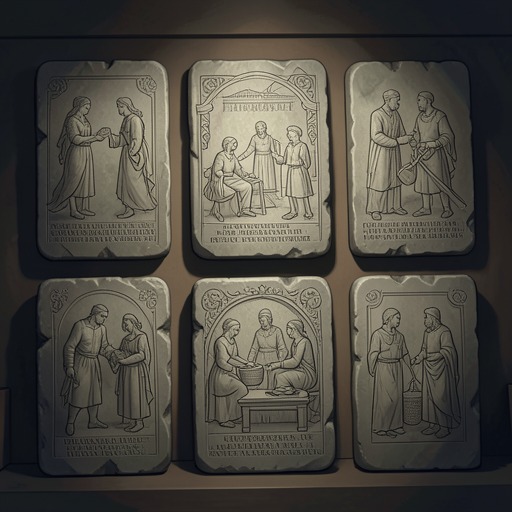
Athenian wives were confined to their quarters and placed under the authority of a guardian, who might be their father, husband, a husband’s heir, or, in the absence of another guardian, public officials. That authority extended to both the woman’s person and her property: a father could give a daughter in adoption or marriage, while a husband could repudiate his wife and transfer her to another husband. Women consequently remained under male or state supervision throughout their lives, with little control over their own legal position.
The law did provide limited safeguards. A wife’s dowry was intended for her support and had to be returned in full if the marriage ended; in rare circumstances, a woman could file for divorce. The account stresses, however, that these protections did not amount to economic or familial independence. Inheritance went to male children, and the dowry was treated less as a woman’s own acquired property than as an obligation borne by her guardian. Its practical effect was that a widow returned to her family’s guardianship rather than becoming the hereditary possession of her husband’s heirs.
Inheritance and the Epiklerate
The epiklerate addressed the problem of a family estate with no male descendants by requiring a female heir to marry her closest eligible male relative in her father’s family. The arrangement kept the property within the paternal lineage, but it did not treat the woman as an independent heir. She functioned instead as the means through which a male successor could be born, and was automatically placed with the family’s eldest man, who might be much older than she was. The institution made inheritance continuity a priority over the woman’s choice of husband.
Prostitution and Social Position
Athens also organized prostitution as a public and commercial institution. Solon established state-run dicterions near the temple of Venus and the port, purchasing enslaved women and placing the establishments under managers responsible for their finances. The women received wages, while the state took the net profit. Private establishments followed; a red Priapus served as their sign, and poor Greek women later joined enslaved women in these houses. The dicterions were recognized as inviolable places of asylum, yet the women who lived there were marked by infamy, denied social rights, and required to wear distinctive clothing and dye their hair with saffron.
Women outside the dicterions occupied different positions within the same broader system. The account distinguishes registered prostitutes, performers such as dancers and flute players, and hetaeras, who could be cultivated companions of prominent men. Some performers became wealthy through their musical talents. Hetaeras, often from Corinth, could manage their own persons and fortunes and gain recognition through intelligence, artistic accomplishment, and their relationships with influential men. Because they lived outside family structures, they could appear closer to men’s social equals than wives confined to the household; Aspasia, Phryne, and Lais are cited as notable examples. These were exceptions, not a general release from women’s subordination.
Confinement and the Public Ideal
The dominant ideal nevertheless confined the ordinary Athenian woman to domestic life. The account describes the classical-period wife as secluded in the household and expected to be an attentive, prudent, economical housekeeper. Men’s authority was reinforced by public attitudes that cast women as unfit for deliberation and public affairs. Plato stands out as an exception for proposing girls’ liberal education and women’s participation in the administration of the Republic; the passage sets his proposal against the prevailing expectation that women remain at home and obey men.
Athens thus brings together two sharply unequal forms of visibility: the citizen wife’s guarded domestic existence and the courtesan’s more public, sometimes privileged life on the margins of family society. The latter could offer a few women cultural standing and control of property, but it did not undo the legal arrangements that made wives dependent on guardians or the wider expectation that women’s lives be organized around male authority.
Athens in the Argument About Women’s Collective Position
Athens also belongs to a broader argument about why women, despite being as numerous as men, have not acted as a unified political group. The account contrasts women with proletarians, Black people in Haiti, and colonized peoples: those groups could assert a collective “we” and oppose the people who defined them as subordinate, whereas women’s historical actions are described as symbolic agitation, with gains conceded rather than seized. Women’s dispersion among men, their ties to fathers and husbands, and their lack of a separate communal space or shared labor interests impede solidarity across sex; class and race divisions further separate women from one another. The couple, in this analysis, binds the two sexes within a shared social unit even as male authority makes women its dependent half.
The city’s household arrangements give this structural account a concrete historical instance. Athenian wives’ dependence on guardians, male-centered inheritance, and confinement at home show how legal and domestic institutions can reproduce women’s subordination without making them a numerical minority. The exceptional visibility of courtesans does not erase that pattern: their relative autonomy arose at the margins of family life and was not a collective transformation of women’s position. Athens therefore serves both as a specific example of gendered control and as part of a comparative analysis distinguishing women’s dispersed condition from forms of oppression organized around a separate class, community, or territory.
Athens in the Argument About Women’s Collective Position
Athens also belongs to a broader argument about why women, though as numerous as men, have not acted as a unified political group. The account contrasts women with proletarians, Black people in Haiti, and colonized peoples, who could assert a collective “we” and oppose those defining them as subordinate. Women’s actions, by contrast, are characterized as symbolic agitation: they won what men were willing to concede rather than taking it themselves. Their dispersal among men, their closer ties to fathers and husbands than to other women, and the absence of their own communal space or shared labor interests impede solidarity; class and racial divisions further divide women. The couple binds the sexes within a common social unit even as male authority makes women its dependent half.
The city’s household arrangements give this structural account a concrete historical instance. Wives’ dependence on guardians, male-centered inheritance, and confinement at home show how legal and domestic institutions can reproduce women’s subordination without making women a numerical minority. The relative visibility and autonomy of some courtesans do not undo that pattern: their position arose at the margins of family life, not through a collective transformation of women’s status. Athens thus serves both as a specific example of gendered control and as part of a comparative analysis of women’s dispersed condition.